Showing posts with label david lawson. Show all posts

Thursday, 9 June 2011

Julia Bradbury - Queen of the Castle

"Sometimes your joy is the source of your smile, but sometimes your smile can be the source of your joy" - Thich Nhat Hanh

TV PERSONALITY Julia Bradbury takes time out from filming BBC’s  Countryfile programme at Chirk Castle to talk to chief reporter David Lawson about what she thinks makes the area so special and why  her  next project is her greatest  challenge yet.

“I FEEL like I should apologise to people when I meet  them,” confesses Julia Bradbury, the smiling face of BBC’s Countryfile and a whole raft  of walking programmes  that  have caught the public’s imagination.
“I’ve suddenly  become one of those people who is  on everyone’s  TVs  all the time,”she laughs, “People are going to start  complaining of Julia Bradbury overload!”
With a little friendly  persuasion, the small crowd of Friday  afternoon visitors  gathered around Chirk Castle’s main gate fall quiet  as  Julia steps  out into the sunshine, repeating an interview  with a National Trust  spokeswoman as her film crew capture it from yet another angle.

The team have been in the area filming a piece for  the 40th anniversary  of Offa’s  Dyke Path, talking to local experts about its ancient woodland and investigating Chirk’s  imposing castle. With her piece to camera finished, Julia  and I head for a nearby bench for a chat while her crew get set up for their next shot.
“We seem to be on some kind of rota at  the moment  that  says  we have to come up to this area at least once every three weeks,”smiles  Julia, “It’s  great, I absolutely  love it  here – I just  wish it wasn’t such a long drive back.”

The last  year  alone has  seen Julia return repeatedly  to the region, from Canal Walks  alongside Chirk’s Llangollen Canal to recording nature pieces  from Lake Vyrnwy’s  RSPB reserve, but  having visited virtually every  part  of the world as  a travel presenter and having now walked across a great  many  of them, I’m curious  to know  what  aspect  of Chirk, Oswestry and our  borderland region she feels sets it apart:
“It’s  the people,”says  Julia without hesitation, “The people here always seem to me to be really feisty, and that’s always appealed to me. I’m a feisty girl myself after all.”
She might  be feisty, but  she’s  also incredibly  popular,her  arrival on Countryfile coinciding with a huge ratings  surge, turning the show  from a sleepy  Sunday  morning affair  into a surprise primetime hit.

As  we continue to chat, school children pouring onto a coach next  to us begin to recognise her, smiling and waving from inside their  bus, with Julia waving and calling back to them. It’s this same genuine, approachable character  that  has  made her  programmes so popular and watchable, yet after presenting so many different types of show from Wish You  Were Here through to Wainwright  Walks she says  she is  still unable to pick out her own favourite.
“Oh, it  really  is  impossible to say, everything I do is  different  and that’s what  makes  it  work for  me. I’d be useless  in an office,”she admits, “I just couldn’t  handle it, but  doing this  job means  each day  I can be doing something new.”

Even so, she certainly appears to have found her  niche with her  immensely successful walking programmes, something that has given her the opportunity to expand into writing books, her latest Canal Walks featuring local sections of the Llangollen Canal: “I absolutely love that!”she enthuses, “I really  enjoy the writing process and I’ve got a great co-author  who I work with, Claire Jones  – another  good, proper  Welsh girl. We have such fun. It’s  definitely something I want to do more of.”


A combination of a tough work ethic and a quirk of scheduling means  you can currently  spend a whole week
watching nothing but wall-to-wall Bradbury, she jokes, from Country File on BBC 1 and Icelandic Walks on BBCFour, to Canal Walks on BBC 2 and constant  repeats  of Wainwright  Walks  on BBC and Sky. Despite this  however, a schedule of constant filming for Countryfile alongside her work for  various  cancer  charities, means  it  doesn’t  appear  as  though she will be disappearing from our  screens any time soon.

So what’s  next? “Having a baby!”she exclaims, unable to hide her  excitement. Currently  five months  pregnant, 40-year-old Julia admits a medical condition called endometriosis  meant  she had not  been sure she would ever  be able to become pregnant. “There’s the Icelandic Walk programme, some other stuff over  the summer  and lots  I want to do in the future,”she says, “but  for I’m just  really  looking forward to being
a mum. I can’t wait!”

Wednesday, 25 May 2011

FILM: Crib Goch Diaries

I had wanted to have a go at some documentary-style film making, so when I began my year long mission to see if hypnotherapy could cure my life-long fear of exposed heights for the paper, I decided to keep a video diary and film my attempt. The film is in two parts below, you can also read the original article here to find out more.


It was quite a steep learning curve. Learning to use new editing software as you go along is tricky enough, but it turns out recording voice over parts is much harder than I thought. It's a little more amateurish than I would have liked, but it was great fun and I would definitely recommend having a go at making one yourself - you'll never watch TV reports in quite the same way ever again.

I must make a big mention of youtube users a7dro and Andrew David (andrewdavid68) whose incredible footage I used in the diaries. I've seen no other footage anywhere that conveys the feeling of Crib Goch like their amazing images - Check out their youtube channels for more great footage!

Tuesday, 8 February 2011

Don't look down! - Hypnotherapy on test

With the help of hypnotherapist Alan Wick and mountain guide Nigel Shepherd, reporter David Lawson gives hypnotherapy its ultimate test on one of Wales' highest and most exposed mountain ridges, finding out if it can really can cure a life-long fear of heights.

THREE-thousand feet above Snowdonia lies Crib Goch, a knife-edge ridge amongst the clouds, that last year I was prevented from crossing by my life-long fear of heights. Now though I was back, to see if hypnotherapy would finally allow me to conquer my fear.

The challenge began 12months ago after my first attempt on the mountain failed to even reach the summit, let alone its nightmarish mile-long tightrope ridge. I should explain that my fear is not strictly heights, but 'exposure' I love high places, but put me on a ladder and I freeze. Transfer that sensation to the top of Wales' most exposed mountain ridge, dropping away hundreds of feet either side and my legs trembled uncontrollably before grinding to a halt.
It was clear will power was not enough, I needed help, but as a hardened sceptic I had initially dismissed hypnotherapy. As I began to run out of options however, my research led me to hypnotherapist Alan Wick who immediately impressed me with his ability to
explain the logic behind his approach.

Alan explains our brains search for old memories that match the situation before us, to know how to act. In my case the only matches involved fear, so my brain's reaction was to hit the panic button, overloading me with adrenalin and fear, creating yet another destructive memory in the process.
Fortunately however, our brains cannot distinguish between a real and imagined experience and this was how Alan planned to help me, creating new positive memories for my brain to find.

Without exception, everyone I mentioned hypnotherapy to asked the same question; "What if he makes you think you're a chicken?"
It's amusing, but shows what Alan's profession is up against, thanks to TV and stage shows, and is the reason the National Council's code of ethics, prohibits members from performing hypnosis for entertainment.
Hypnotherapy itself felt like a vivid daydream, guided by Alan, visualising the environment that scared me but without the fear. As the sessions progressed the hypnosis became deeper and more effective as Alan built in tools to help me in case I started to panic, the most effective of which involved visualising a dial with which to control my emotions.

Under Alan's expert guidance it was a very enjoyable experience and at every stage I was in control and aware of what we were doing. The first time I was put into a relaxed state, I admit I was taken aback by its effectiveness, but immediately realised I could simply get up and walk away at any time.

Alan says most straight forward phobias can be dealt with in around four sessions and after five weeks, daily exercises and a nightly CD to listen to, I was ready. In the weeks that followed however, an unhelpful voice in my head kept asking "what if it doesn't work?"
Two of my closest friends have accompanied me on all my mountain adventures and had been with me on Crib Goch the previous year, but as desperately as I wanted them there this time, I did not want them to be responsible for me if things went wrong.
That said, I also realised this was not something I could tackle alone. Nigel Shepherd of Penmaenmawr is an international mountain guide and one of the UK's leading mountain experts, so I was delighted when he agreed to join me. With Nigel onboard my preparation was complete and there was only one thing left to do.

I had slept little the previous night and driving through Snowdonia beneath a darkening sky, was painfully aware that months of preparation were reaching their conclusion. As the road curved around the mountainside my heart skipped a beat, as I caught my first glimpse of Crib Goch sliding silently from the mist.

At a windswept Pen-y-Pass I was encouraged to find Nigel enthusiastic and cheerful, but he warned me that what would be a challenge for me in fine weather, may be impossible in high winds
I always thought I knew the mountains, but under Nigel's instruction they took on a new dimension and as we left Snowdon's easy paths, and climbed into the mist, he explained the different coloured rocks underfoot; which would grip even when wet, which would slide and which were likely to crumble at the slightest pressure.

Alan always stressed we were not trying to eliminate my fear, leaving me oblivious to danger, but simply prevent it overwhelming me, and as the route became steeper and we passed the point where I had stopped the previous year, the sensation was like a strong flu medicine. The symptoms were still there, but distant and blunted. No paralysing fear, just an awareness of increased risk.
With Nigel guiding me I continued upwards, making sure of each hold before reaching for the next, until finally we breeched the summit and could look out along the ridge.

Crouched low we waited, allowing the strongest gusts to pass, howling banshee-like as they whipped carpets of mist screaming over the rock edge into oblivion.
Moving along the steep left-hand side, using the peak as a handrail, we worked our way towards the Pinnacles. Even in my nightmares the ridge never held so much fear for me as the Pinnacles, three jagged outcrops guarding the ridge, threatening to ensnare the timid between them. With Nigel's help the first two proved straightforward, but I knew what was coming.

I had always hoped videos I had seen of people climbing the third Pinnacle had been some alternate route for crazy people, but as we reached its base it was clear the only way up was a stomach churning climb out onto the sheer right side.
A few months ago the mere thought of this set my heart pumping. But now, while I could hear my brain's warnings that I was nearing my limit and any slip could surely only have one outcome, I was not paralysed by fear. I used Alan's techniques to calm myself, weighed up the situation and made my decision.
Stepping out onto the first ledge I was instantly aware of the drop beneath me. This was by far the most exposed position I had ever experienced and I paused instinctively, braced against the ice-cold fear sure to come shooting through my veins. But nothing happened. Up onto the next ledge, and the next, and the next and over the top. I could hardly believe it.

From there the descent towards Snowdon was a blur of elation and only when we dropped back below the clouds to Snowdon's gentle paths, did I finally stop to take it all in. Hundreds of feet below, the icy waters of Lake Glaslyn had never looked so blue

For days after I felt quiet, almost humbled. I had been unable to imagine life without this fear and it took time to adjust.
I was unprepared for how powerful and effective hypnotherapy could be, and this in turn impressed on me the importance of choosing the right hypnotherapist.

In the same way that you would only chose an expert like Nigel to guide you on the mountains, I believe you should only chose an expert such as Alan to guide you through hypnotherapy. Not only will this give you the best chance of success, but knowing you are in the hands of an expert will allow you to relax and truly enjoy the experience.

____________________________________________________


Hypnotherapy Diary

Week One: Initial consultation and given a CD to listen to as I go to sleep. Alan explained our brains naturally filter what people tell us, but as we drift off there’s a period when we still take in information though the our conscious mind is switched off (like falling asleep infront of the TV) this is the best time for that kind of suggestion to work and a similar state to hypnosis.
Week Two: First hypnosis. Lying listening to Alan, I wasn’t sure it was doing anything. Was only when he counted me back out of my relaxed state that I realised just how emersed I had been. Very pleasant. CD is proving effective. First time I used it was surprised to feel myself relaxing.
Week Three: More hypnosis. Listened to CD while properly awake. It’s designed to boost self confidence and I noticed I have been walking taller and feeling noticeably more confident (despite strangling myself with the headphones). Given new self-hypnosis ‘homework’ to do.
Week Four: Hypnosis much deeper and more specific to the mountain now. Building new ‘fake’ memories. Imagining it so vividly I actually felt the sick feeling in my stomach at one stage. Stopped and started again, repeating it until able to experience it without the fear.
Week Five: Developed an ‘anchor’ linking feelings from a happy memory to an action (pressing thumb and forefinger together). Allows you to trigger those feelings at will whenever you start to panic. Also learned to control subconscious by visualising a dial and simply an emotion up or down which seemed particularly effective.

CLICK HERE FOR CRIB GOCH VIDEO DIARIES
____________________________________________________


Nigel Shepherd
MOUNTAIN expert Nigel Shepherd from Penmaenmawr is one of the UK’s foremost authorities with over 30 years experience.
- Qualified as a Mountain Guide 1979. Mountain Guides Association Training Officer 1986-1989. President 1993-96.
- Has worked everywhere from New Zealand and Australia to Greenland, Norway and Nepal.
- Author of books on ropework and rock climbing, his photography is also widely published.
- Available for off piste skiing, touring, alpine trekking and climbing.
A GRADUATE of Bristol's Clifton Practice Alan worked in nursing for 20years before using hypnotherapy to quit smoking. Realising its potential, he retrained, established Positive Hypnotherapy, and began refining his Solution Focussed Brief technique.
- A member of the National Council for Hypnotherapy, Alan recommends people only use therapists signed up to a strong regulatory body
- Says hypnotherapy can help with smoking, weight loss, problems sleeping, anxiety and depression, sport, performance, phobias such as flying, spiders and needles, compulsive behaviour, drinking, gambling or drug use, and can even aid pain relief in childbirth.
- Holds clinics in Wrexham, Chester and the Wirral, Oswestry and Nantwich


Friday, 5 March 2010

Eddie Izzard - Marathon Man

“We are different, we are the same, we are United Kingdom, we are Africa. We are humanity!” Eddie Izzard

With BBC Three currently airing their three part documentary following comedian Eddie Izzard on his 43-marathons in 51-days for Sports Relief, here’s the article I wrote having caught up (but only just) with him as he ran through Oswestry and Chirk (at the time aiming to complete a mere 30marathons). Have a read then please donate to his challenge at http://www.sportrelief.com/

WHEN Sir Ranulph Fiennes announced he would attempt seven marathons in seven days, I remember being impressed though not exactly shocked, but when comedian Eddie Izzard announced he was to run 30 marathons in 30 days however, I was probably not the only person waiting for the punchline.

Amazingly though, last week the world famous comedian, who most recently starred in the blockbuster Valkyrie alongside Tom Cruise, arrived in Oswestry on the 13th day of his incredible challenge, having run at least a marathon distance every day and hitting the 30- mile marker on a several occasions. Having caught up with Eddie on the outskirts of Chirk, we joined him as he crossed the border into Wales and caught up on his challenge so far.

“OH WOW, that’s right, he did, didn’t he!” says Eddie, genuinely startled, as I mention Fiennes’ seven marathons in seven days, perhaps for a brief moment realising the scale of what he himself has achieved already, nearing the end of his 13th back-to-back 30-mile day.

OK, admittedly Fiennes’ marathons came just three months after a heart bypass, but let’s be honest, the world’s greatest living explorer is just the kind of person you would pick for such a feat of endurance. If you sat down with a piece of paper and drew up a challenge more than three times as long, I’m not sure too many people would have Eddie Izzard at the top of their list of potentials.

But that, he explains, is the point of the challenge: “I really do believe this is something we all have in us and that it is in our genes to be able to do this kind of thing. “For centuries, people have run like this for days, hunting food and tracking down their prey, and in other parts of the world people still do and have retained that ability.

“Even here though, I believe that if say another world war broke out tomorrow and we were forced to run, either for our survival or to fight, I feel we would all find the capacity.”
In all Eddie will cover 1,000 miles in seven weeks, raising money and awareness for Sports Relief. Not bad after just four weeks’ training!

“Sport Relief asked me if I would like to do a sporting challenge. I had always wanted to do a big physical running challenge and this seemed a great way to do it and also raise money to help Africa and the poorest countries in the world as well as projects that Sport Relief fund in the UK.
“I told them I wanted to try to run around the whole of the UK. London to Cardiff to Belfast to Edinburgh and back to London.
“They said ‘Great. You’re nuts’. They said ‘How far is this?’ I said 1,100 miles. I will try to run 30 miles a day for six days a week. It will probably take seven weeks.
They said ‘Right, anything else?’ Yes, I'm leaving in five weeks!”

As we headed for the Welsh border at Chirk, Eddie prepared to change from the English flag he had been carrying to his Welsh one, a symbolic gesture at the heart of his chosen route.
“It started as a vague idea, but has become something of a mantra and is the reason I’m not just carrying the Union Jack,” he explains. “I tell people; we are different, we are the same, we are United Kingdom, we are Africa, we are humanity.

“I’ve been really enjoying this part of the run, you’ve got great history - being the place where Oswald was killed in battle - the scenery is beautiful and I’ve been able to watch the butterflies and the bees as a I go by, which takes my mind off running, but that’s part of it too. I could be running here, or in Africa, or in Yemen - where I was born - and still find that beauty, we’re all part of the same thing.”

As we left Eddie continuing on towards Wrexham, I couldn’t help wondering if he was right. Perhaps we really do all have, built into the genes of our ancestry, the capacity for such incredible feats of endurance. After less than a mile however my genes were telling me they would rather I went back to the office and donated online. You can do the same by visiting: http://www.sportsrelief.com/donate/eddie or http://www.eddieizzard.com/

Saturday, 30 January 2010

A very brief Ripping Yarn

“I always wanted to be an explorer, but - it seemed I was doomed to be nothing more than a very silly person.” Michael Palin

I recently travelled to London on the new Wrexham & Shropshire trains in the hope of "a few words" with adventurer and comedian Michael Palin, only to find you should be careful what you wish for!

CUTTING a lonely figure on Gobowen Station at 5am I can't help thinking I should have a voice over, at the very least a ticking clock and stirring BBC theme tune in the background.

I was too young for Monty Python and as a nine-year-old, most TV was an excuse not to go to bed, but then came Around the World in 80 Days, which had me sitting gripped on the edge of our settee, as the impossibly nice and terribly British Michael Palin raced across mysterious far off countries from one adventure to the next.

There are not many people I'd get up at 4am to meet, but for the chance of a few words with Michael Palin I found myself on a cold Gobowen platform alongside a handful of hardy earlybirds as two white discs emerged from the black, rumbling through the frozen darkness as the sleek gunmetal grey Wrexham and Shropshire train glided into the station.

It's a far cry from Palin's adventures on ramshackle trains with as many passengers ontop of the train as inside it. Onboard the new state of the art carriages I therefore feel a bit of a fraud as I slump into the smart grey seats of standard class. Incidentally if grey seems to be a recurring colour there's a good reason. In their attempt to persuade people out of their cars the operators explain they decided to emulate the understated greys, chromes and carbon-like materials of expensive cars that people seem to like so much.


While the Palin of old may not recognise the luxury, he would certainly recognise the route I'm travelling. Infact it was on this route that one of the railways' staff found himself sitting next to the affable comedian, on his way to give a speech at his old school in Shrewsbury. So impressed with the service was Palin that he had offered free of charge to help launch the new trains.

I use the first part of my 3hour 47minute journey to gen up on Mr Palin, but trying to think of questions he might not have been asked in his thousands of interviews is a real challenge. Almost all seats on the trains now have a table, laptop power points and free WiFi internet, so I spread myself out and carry on reading his Monty Python dairies. There's plenty I want to ask him; What his old school reports say? What does he list for 'occupation' on his passport? ...and was that parrot really just sleeping?

The trains are stunningly quiet, even the wheels have been coated to reduce noise and as we charge southwards I fall asleep, victim of comfortable seats, and a 4am start. I would normally wake in a panic (having woken up in Abergavenny before now), but the direct service means you can relax, assured of ending up in London, and I wake to find the carriage has filled around me with visitors and commuters combining country living with London wages.

London Marylebone is a pleasant place to arrive; small, unintimidating and just metres from the waiting busses and tubes, but as more and more journalists began to gather, I realised my chances of interviewing Palin were getting smaller by the minute.

It's a sad fact of journalism that newspapers almost invariably play second fiddle to TV cameras.Amidst a sea of cameras all hope seemed lost.

Being usefully taller I got the photos I needed, but the ever smiling Palin was quickly ushered away to meet train bosses, MPs and the waiting TV cameras.

At this point in one of his adventures we would be listening to Palin's narration, describing an ingenious solution the difficult obstacle infront of him.

"This looked like turning into a disaster," said my own Palin voice over unhelpfully as the minutes ebbed away.

Then came my chance. As he made to leave I headed him off at the pass and grabbed the unfortunate 66-year-old as he waved his goodbyes: "Oh! Hello, how do you do? A picture? Yes of course," smiled the bewildered Palin as a hired help snapped our photo.

And that was it. Not the indepth, inciteful interview I had hoped or planned for, but perhaps a fitting reflection of my own trip on the new Wrexham and Shropshire trains. Just like the service to London, it's invariably the destination that entices us, but more often we find that it's all about the journey.

Tuesday, 5 January 2010

Heart of a Dragon

“It doesn't take a hero to order men into battle. It takes a hero to be one of those men who goes into battle.” Norman Schwarzkopf

AN INCREDIBLE new work charts Wales’ Victoria Cross recipients, including the exploits of Thomas Pryce, sonof a Llandrinio snake skin merchant, who in the First World War held back the enemy’s advance for 10 hours with just 40 troops, running out of ammunition before leading his 17 surviving men in a final bayonet attack.

In Heart of a Dragon, charting the Victoria Crosses ofWales and the Welsh Regiments from 1914-82, historian Alister Williams has uncovered an amazing amountof information, pulling together photos, recollections,reports, certificates and maps, including those of anumber of local heroes like Thomas Pryce.

Thomas Pryce Snr had been a tea, coffee and snakeskin merchant in the Dutch East Indies, a Montgomeryshire magistrate and akeen historian. His son – also Thomas Pryce – was born in 1886and went on to become Captain of 4thBattalion The Grenadier Guards, receiving the Victoria Cross after hewas killed in action at Berquin, France in April 1918.
As the author explains, Pryce’s heroics were not just a single unconscious act, buta prolonged battle against overwhelming odds, lasting more than a day.
Having received orders to clear a village at Vieux Berquin, Pryce led two platoons fromhouse to house, taking out 30 enemy soldiers, seven of which he killed himself. His platoons suffered heavy casualties however and the following morning he found himself occupying a position with the remaining 30-40 men when his left flank was gradually surrounded by the enemy, allowing them to fire down the length of his trenches. That day, Pryce and his men repelled four attacks andinflicted a greatnumber of casualties,but the enemyused this period tobring forward three large field guns within 300yards of his line,whose devastatingpower soon demolished the trenches,leaving Pryce and hismen without cover. By 6.15pm theenemy had workedtheir way to within 60yards of their position. Pryce called upon his men, telling them to cheer, charge the enemy and fight to the last, before leading the way out of the trench, where he and his men managed incredibly to drive the enemy back some 100 yards.

It was a brave effort,but half an hour later the enemy had again closed to within 60 yards and in greater numbers. By now Captain Pryce had just 17men left and every round of ammunition had been fired. Determined there should be no surrender, he once again led his men in a bayonet charge, his citation saying he was last seen ‘engaged in a fierce hand-to-hand struggle with overwhelming numbers of the enemy.'

The Victoria Cross was presented to Pryce’s widow by King George V atBuckingham Palace in April 1919, Prycehaving also received the Military Cross with Bar. In Heart of a Dragon, Alister Williams explores Pryce’s background, gaining a sense of the character of the man, as well as unearthing some poignant sources, including his last message to battalion HQ, telling them: “My left flank is entirely in the air. The KOYLI [King's Own Yorkshire LightInfantry] has gone. Enemy advancing. Find Thomas...”Other sources include a letter to his widow in which the Grenadier’s commanding officer wrote: “Your husband was perfectly splendid and his record will beone of the finest episodes of the war.”

Williams adds that among the men whofought at Vieux Berquin was a Guardsmancalled William Henry Warburton who wastaken prisoner and was later able to reporthe had been standing alongside Pryce whenhis captain was shot in the head.Pryce’s official posting of ‘missing’ was finally changedto ‘killed in action.’ His body was never identified but his name is recorded on the Memorial to the Missing at Ploegsteert in Belgium.

Review

Heart of a Dragon is a fantasticpiece of work, and while it standson its own, is actually the second volume produced by historian Alister Williams, the first having covered the period from 1854 to 1902.

It’s easy to see why this labour of lovehas taken more than 30 years to complete,going into incredible detail to document the exploits and background of more than 50 VC recipients in this one volume alone,recording not only their essential serviceand personal details, but also the storiesbehind their citations, revealing some fantastic characters.Alister says that among his own personal favourites was Lionel Rees, who in 1916 became the first ever ‘fighter pilot.’ The story of his VC was remarkable enough, but Alister says what he did after the war said just as much about his character, teaching himself to sail, before setting off for the Bahamas, a 65-day solo ocean voyage for a complete novice with no communication or chance of rescue.

Once there, Rees, by now in his mid 60s, caused considerable gossip among the white community by marrying the 18-year-old daughter of a black family on the island of Andros, where he lived out the rest of his life.

Priced £35, the beautifully presentedvolume of almost 500 pages and 1,000 photographs is a real gem. The vast time and effort invested really shines through, while the absorbing stories will keep you gripped for hours.
Available from http://www.bridgebooks/.co.uk (ISBN 1-84494-028-4)

Thursday, 24 December 2009

The War Underground

"To rid ourselves of our shadows, we must step into either total light, or total darkness" Jeremy Preston Johnston

AS THE cage doors closed on Hanmer's Arnold Ballard and the elevator hurtled ever deeper into the coal black mines, the 19-year-old resigned himself to leaving behind his family and friends, spending his Second World War in the alien underground world of the miners, as one of Britain's 'Bevin Boys.'


Even back in 1943, few were aware of the Bevin Boys, least of all 19-year-old Arnold Ballard who returned home from his honeymoon to find a fateful letter waiting for him.The man who had given his name to the programme was Ernest Bevin, the Minister of Labour and National Service for the wartime government which at the outbreak of war had begun desperately conscripting men into the armed forces, not foreseeing the difficulties a shortage of experienced coal miners would create.


By the time they realised what they had done, the coal mines had lost more than 35,000 of workers, and when attempts to persuade volunteers to replace them in time for the winter failed, Ernest Bevin announced plans to take a percentage of the conscripts to work in the mines.

"We need 720,000 men continuously employed in this industry," said Bevin, "This is where you boys come in. Our fighting men will not be able to achieve their purpose unless we get an adequate supply of coal."


News of the selection came as a real shock for the young men chosen, not least Arnold Ballard who was all set for life in the armed forces: "I was stunned," he said, "I was just back from my honeymoon and there was the letter waiting for me."I had hoped to join the Navy and wanted to be a medic, having done Red Cross certificates and training, so this came a real shock.


"Having prepared himself mentally to go to war and fight alongside his friends, the news that he would spend the war down the mines and hundreds of miles from his friends was hard to take in: "The selection was random. Each week they would pick a number and the men whose national service number ended with that number would be sent down the mines. I forget what the number was that week, but I didn't know anyone else who was selected.


"For those sent to the mines there was little chance to appeal the decision. Even those suffering claustrophobia, for whom the mines would have been a worse kind of hell than the battlefield, had little choice in the matter. One of the Bevin Boys who suffered from just this condition wrote that after psychiatric assessment he was informed he could either report for the mines or accept three months in prison, after which he would be given the same choice, again and again and again.


Only certain professions vital to the war effort were made exempt and though Arnold might have reasonably expected his medical training would secure his place in the armed forces, such was the desperate situation back home that even these skills were given up in favour of coal and energy. Like countless others he appealed, but like countless others he received his orders to report for training.


Arnold and his fellow intake received four weeks of hard physical training to ensure they were physically able to carry out the gruelling work, followed by two weeks at a disused mine in Sheffield. In no time they were reporting for work at Glapwell colliery in Derbyshire."The first time the doors slammed shut on the cage my heart was in my mouth," said Arnold, "I had no idea what to expect down below and it took off downwards at an incredible speed."


That first experience of hurtling down into the mines, surrounded by unfamiliar faces was an ordeal shared by all the Bevin Boys, packed in nervously among the joking regular miners for who this was just a normal Monday morning, but while the miners would have been used to what greeted them, for newcomers like Arnold, the sight was beyond anything he could have imagined:

"It was like a complete village underground," remembered Arnold, "there were offices, stables and horses, and tunnels - or 'gates' - each heading off to different coal faces."I was put to work on the iron rings which support the gates and tunnels. The huge weight of rock would gradually cause them to subside and it was our job to lift them back up to the proper height."


Arnold's first 18 weeks in a row were spent working the night shift, something he says took a long time to recover from. There was no shortage of danger either, with the inexperienced new miners facing terrifying underground accidents for the first time. Arnold may have been grateful his role did not involve working the dusty coal face, but as one of the men responsible for keeping the tunnels open, he could expect to be called to dig out rock from the cave-ins.


"After some months, the family I stayed with had allowed my wife to come and stay with me. I remember the one day I had left as usual at 10 o'clock and by 12 the next day I had still not come home which left her incredibly worried.


"There had been a tremendous roof fall not long after I had arrived. It was incredible, if you looked up all you could see was the vast black hole above and we had to work around the clock to try and clear it. You had to work quickly, but you were never sure if the rest of it was going to come crashing down."

Despite the risk involved, Arnold said he preferred his work to the unfortunate souls sent to work the coalface, unprepared for the explosions and thick choking dust of the mine's outer reaches.Conscripts received helmets and steel-capped safety boots but most had to wear whatever clothes they already owned. In some places, being of military age but without a uniform led them to be questioned by police, while there was also a popular misconception that the Bevin Boys were conscientious objectors, as this was where a number were sent, making them unpopular with the families of those fighting.


Arnold says luckily he did not encounter much of this kind of attitude, partly because the area was so used to miners that its inhabitants were among the few who realised what the conscripts faced underground.As time went on and Arnold and his intake gradually grew to know the mines and become proficient and familiar with their workings, he says it was strange to see the new raw recruits arrive at the bottom of the mine shaft with that same expression of fear and awe on their faces, realising that he and the others had become the 'old hands' helping them learn the ropes.


Arnold's time as a Bevin Boy was brought to an abrupt end 18 months later, by a medical discharge: "I remember being sent to see the doctor, who thumped my back at which point I nearly fainted. He just said, 'well, you're not faking it' and that was it. There was no compensation, no-one you could see about it, you were just out."


The Bevin Boy programme was wound up in 1948. The men received no medals and unlike the armed services did not have the right to return to the jobs they had left at the start of the war.To add insult to injury, the men were not even fully recognised as contributors to the war effort until 1995, 50 years after VE Day. After a further ten years, Prime minister Tony Blair the conscripts would each receive a Veteran's Badge to honour their efforts, but Arnold says he considers the tiny cheap-looking pin he received, depicting an incorrect drawing of a winding gear, an embarrassment and an insult.


As the soldiers returned home to medals and a heroes welcome, thousands of Bevin Boys finally emerged from the darkness of the mines, with no medals or uniforms to prove they had taken any part in the war effort.


Only now have we really come to understand just how important their role was and that without the coal they mined and the energy they produced, Britain would have been lost long before the war could be won.

Monday, 8 June 2009

A Ship Called Oswestry - Part 2

While the second ship to bear the name of Oswestry Grange may have been an adopted member of the family, it met with a similar end to its predecessor, falling foul of one of the most devastating convoy attacks of the Second World War... Convoy SLS 64.


Part Two: The Rhodesian Prince

AS THE first World War ended, the Houlder Brothers shipping company looked to replace the first Oswestry Grange, sunk in a U-boat attack. A new ship, The Rhodesian Prince, was bought and renamed to replace her, but less than four years after Oswestry’s name had been painted across her side, it would face an even more devastating attack than its predecessor.

It was 1937, some 20 years after the demise of the first Oswestry Grange that it’s replacement took to the Houlder supply routes, enjoying just four years of plain sailing. By late January in 1941, enough ships had assembled at Freetown in Sierra Leone, to make up a convoy, but from the outset things looked bleak.

Nineteen of the merchant ships were in such a poor state that they could not maintain the minimum convoy speed of nine knots, but worse still, the navy then announced they could not spare enough ships to escort them.

Convoy SL64 set sail for Liverpool, passing by the navy gunships in port as they headed out to sea, where the 19 slower vessels were soon left behind, leaving the remaining 28 ships to plough on with just a single ocean escort for defence.

A few days in, news reached the crew of Oswestry that convoy HG63, who had started out just a few days earlier, had been attacked. The German submarine U-37 and a squadron of Condor aircraft had sunk six of the ships and damaged a seventh, which had also later sunk, but just when the surviving vessels had thought the worst was over, a large unidentified destroyer had loomed onto the scene, sinking the defenceless Iceland.

The days that followed would have been agonising onboard Oswestry, whose 42 men knew they were being hunted and must have holding their breath as their convoy attempted to slip by unnoticed. Finally there was relief, when two days later on February 19, it seemed the navy had had a change of heart and come to their aid.

The convoy’s log entry read: “06:05 - The Margot sights strange Man o’ War” but it was then that the large unfamiliar ship on the horizon hoisted its battle ensign. It was the Admiral Hipper.


A steely 200m long metal giant, the Admiral Hipper was the first of it’s kind. A new class of German heavy cruiser, designed for the sole purpose of smashing allied supply lines. It was hailed as a new breed of merchant raider, but it’s first outing had not gone well, inflicting only minor damage before engine problems forced the metal monster to limp embarrassingly back to port for repairs. It had remained there for more than a month. Now, finally returned to sea, the Admiral Hipper was out to prove a point.

For Oswestry and the convoy, there was no chance of escape. More than 18,000 tons of German military might was bearing down on the convoy at 30knots. The Hipper carried a crew of 830 and was heavily armed with eight-inch guns as well as 21inch torpedoes, and it was just a few minutes before she was within range and brought her guns to bear.

The Hipper opened fire on the convoy from 3,000 yards. The convoy’s commodore immediately signalled for all ships to alter course, but in their haste the Margot and Blairatholl altered early. It was just what the Hipper had been waiting for and it attacked, destroying first the Warlaby, then the Derrynane, the Westbury, Perseus, Borgestad, Lornaston and finally the Oswestry Grange.

Three ships Derrynane, Borgestad and Lornaston attempted to fight back opening fire on the Hipper, the Borgestad even appearing to hit its control tower, but in return for their display of defiance, the official report describes the three ships as receiving “very heavy punishment.”

The Derrynane and Borgestad were sunk with all hands lost and the Lornaston left badly damaged as the Hipper turned it’s attention back to the merchant vessels, opening fire on the Margot, before the worsening weather came to the convoy’s salvation, forcing the cruiser to break off it’s attack.

Oswestry had been hit in the engine room on her port side, damaging her bridge and shelter deck.

The crew managed to launch the lifeboats and 37 survivors were picked up five hours later, but one boat had been damaged and capsised, drowning five crew. These men are commemorated at the Canadian Halifax Memorial, while George Medals were awarded to the ship’s British, Greek, and Norwegian captains.


It was a desperately sad end for the second Oswestry Grange, while the Hipper would go on to become known as a potent but temperamental killer, deadly at sea, but spending more and more time under repair.


Hitler would eventually become disillusioned with the Kriegsmarine surface fleet and after the Admiral Hipper was used, partly-repaired, to evacuate troops from the Eastern Front, it was scuttled in dock at the Kiel Deutsche Werke yards in 1945, before being broken for scrap in 1948.


CLICK HERE FOR PART ONE - The Oswestry Grange


CLICK HERE FOR PART THREE - Tiger Bay

Friday, 29 May 2009

A Ship Called Oswestry - Part 1

Between 1902 and 1970 four ships criss-crossed the Atlantic, running the gauntlet of the allied supply lines in two world wars, ferrying passengers to Australia, bearing witness to the passing of New Zealand’s greatest leader and even taking a starring role in a Hollywood movie, before being sunk by German naval forces. What linked these ships was their name... Oswestry.


Part One: The Oswestry Grange

The first Oswestry Grange was one of two ships built by shipbuilders Workman Clark in 1902, more than 6,500 tons of steel, shaped into a single funnelled, four masted steamer, 450ft long and capable of 13knots and with accommodation for 39 passengers. Oswestry took her place on the Federal-Houlder-Shire Line service travelling from Britain to Australia and New Zealand.

It was a boon time for the service and as one of its flagships, Oswestry transported dignitaries including New Zealand’s greatest and longest serving prime minister, Richard John Seddon. It was just before setting foot on Oswestry in 1906, that Seddon returning from Australia, sent a famous telegram to the Victorian premier, “Just leaving for God’s own country,” he wrote. Seddon would never see New Zealand again, dying onboard ship the following day, but his description of the country has endured to this day.

In 1912 Houlder Bros disposed of most of their Australian trade and Oswestry was sold on to the Union Steamship Company of New Zealand as the freighter Roscommon. It was during this same period that German high command placed an order for a new batch of their feared U-boat submarines, and while Oswestry was put to work on the supply routes, U-53 was being quietly assembled in Germany’s Germaniawerft Kiel shipyard.
It was finally ready for launch on February 1, 1916 under the command of Hans Rose and would cross paths with Oswestry just once, but with deadly effect.

The sub soon developed a fearsome reputation. Germany had hoped to use submarines to slip supplies past the Allied blockades and had fitted out the weaponless Deutschland and Bremen subs to carry cargo. The ballast tanks of U-53 were specially adapted to carry extra fuel so it could escort the Bremen, but Lt Rose instead put this extra range to more devastating use, emerging unexpectedly just outside US territorial waters and sinking five ships in an attempt to intimidate the Americans. Meanwhile, the cargo carrying Bremen, departed for America, but disappeared en-route.


Early on the morning of August 21, Oswestry was one of 19 steamers attempting to slip unnoticed out of Northern Ireland’s Lough Swilly. It was a tense time, and the fleet began the long process of manouevering from single file into convoy formation, unaware of the submarine below stalking it’s prey. It took almost seven hours to move the convoy into position, but at 11.30am the formation was complete and with a sense of relief, the ships finally began to get under way.

Suddenly alarm bells rang out as the destroyers picked up three torpedoes, headed straight for the ships. There was no time to react. The first torpedo struck the Devonian at the head of her column, a second skimmed past the lucky Vasari just behind her, but the third of U-53’s torpedoes found its mark, striking the second ship on the portside column... Oswestry was hit!


The convoy’s Destroyers immediately launched a counter attack, protecting the stricken ships from further assault, but U-53 was gone, the assassin slipping silently back out into deep water and making good its escape. Five of Oswestry’s crew were killed in the attack, but miraculously, 80 made it to safety, abandoning ship and reaching land.

Captain Trant of The Devonian later spoke of the danger of assembling such long lines of vessels, sometimes up to 12miles in length: “The hours spent forming the convoy had given the submarine ample time to prepare for the attack,” he said, “resulting in the loss of two large and valuable merchant-vessels.” It was a sad end for the first ship to bear Oswestry’s name.


U-53 would prove to be one of the German’s most potent convoy killers, sinking almost 100 ships before it was eventually surrendered and broken up in 1918, but ironically, while the submarine’s earlier attack on a US port had succeeded in intimidating the Americans, it ultimately did not have the effect its commander had hoped.

The Americans had been surprised when the weaponless sub Deutschland slipped the British blockade and suddenly appeared in Baltimore with cargo to trade, but it was the devastating surprise attack by U-53 far beyond a U-boats’ normal range, that would spur the Americans to channel even greater resources into their naval forces.

CLICK HERE FOR PART TWO - The Rhodesian Prince


CLICK HERE FOR PART THREE - Tiger Bay

Thursday, 5 March 2009

In the time it takes...

"Of all that is written, I love only what a person has written in their own blood" Friedrich Nietzsche

CAN five minutes sat in a chair really change someone’s life forever? What if there was something you could do in that time that cost you nothing, but had the chance to save a person’s life.

Having had a successful bone marrow transplant last year, leukemia patient Ben Walters from Glyn Ceiriog organised a Bone Marrow Register clinic through the Anthony Nolan Trust, which saw around 50 people join the register, which searches to find matches for those needing a transplant.

Having heard how easy it was, I went along to the clinic held at Bellan House and, arriving early, was amazed to find a dozen others had beaten me to it and were already finished.

I spent a couple of minutes reading a leaflet and filling in the form, another minute to realise I had ticked a wrong box (I don’t remember being pregnant in the last six months) and then it was into a room where a nurse took a tiny blood sample... there was even tea and a biscuit!

So what happens now? Well, my blood sample is sent away for testing and a record of my bone marrow stored on the Bone Marrow Register. On average just one person in every thousand turns out to be a match, so the chances are I will never be called upon, but for those that are, all that is needed is a minor medical procedure requiring a few days off work.

The register includes potential donors from 18 to 40 years of age, but as Ben explained even people at the end of that range should not be put off: “The one and only match for me was a 39-year-old, which shows how important it is to join the register even if it’s only going to be for a year.

While donating is a relatively easy process for the donor, it’s a rough ride for the person waiting for it. After intensive chemotherapy to kill off their existing bone marrow the new cells are introduced.

Ben says he remembers seeing the tiny pack of blood arrive for his transplant and was shocked such a small amount could have such a life changing effect.Anonymous

Once his bone marrow was killed off, Ben had to remain in a completely sterile environment, as without his body’s normal defence even the smallest infection could have been disastrous: “You have basically wiped the slate clean, so since then I have had to have all the children’s immunisations again and have gone through all the childhood illnesses like chicken pox.”

Donors remain anonymous for two years, then – if they wish – have the chance to meet: “I really hope I do get to meet him, to say thank you and find out what made them join the register,” said Ben, “Having had the transplant I can’t join the register myself, so I want to do what I can to raise awareness, persuade others to join and increase the chance of finding a match.”

Just think, those five minutes in a chair will either be a few moments out of your day, or could be the most valuable thing you ever do in your life.

To find out more or to join the register visit www.anthonynolan.org.uk or phone 02072 841234.

Monday, 12 November 2007

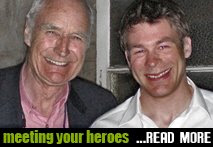
Meeting your heroes


"Without heroes, we are all plain people and don't know how far we can go." Bernard Malamud

Meeting heroes is a risky business, but who can resist when given the opportunity? I recently had the chance to meet and interview Peter Snow who I first remember from Tomorrow's World. Growing up without a dad, grandads or uncles around, television helped fill in the gaps, and for me like many others, Peter was everyone's favourite uncle, who over the years taught me about inventions, politics, lost civilizations and bygone battles.

He's a wonderful chap, every bit as warm and funny as you'd imagine, though much more calm and relaxed than people make him out to be. It really was great fun, but as I've promised to stop boring my friends with the story, here it is one last time. Thanks Peter!


- Mid Wales & Border Living / Border Counties Advertizer -

Peter Snow and David Lawson at the Ludlow FestivalFrom Newsnight to Twentieth Century Battlefields, for more than 50 years, Peter Snow has been one of the most respected and recognisable faces on British television, taking time out from a hectic schedule to talk to Chief Reporter David Lawson.

“David, how wonderful! Delighted to meet you.” Peter Snow, bursting with enthusiasm is clearly enjoying himself as he comes off stage after his Battlefields lecture, the final event of this year’s Ludlow Festival.

Most will recognise Snow from BBC2’s Twentieth Century Battlefields, or remember his Newsnight and election broadcasts. As for me, having grown up watching Peter on shows like Tomorrow’s World, when I became a reporter I was determined to try and emulate that same style and energy in my own reports. It’s not often you get to meet your heroes, so I had jumped at the chance to meet him in person.

There aren’t many people who make me look small, but at a little under 6ft 6ins, Snow towers over the crowd gathered at the exit to Ludlow’s Assembly Rooms, telling him how much they enjoyed the evening. As they head home, Peter and I make for one of the nearby pubs and sit outside.

“So what did you think?” he beams keenly, eager for a second opinion, not that he need worry. After more than 50 years broadcasting from around the world, he’s a polished presenter and his latest Battlefields series has given him plenty to talk about: “They’re such pivotal events,” says Peter on people’s fascination with wars, “They’re moments when whole nations could have taken massively different paths, but of course the reason we find them so powerful is the human sacrifice involved.”

Focusing on this human element has been the job of his historian son Dan, and Peter tells me working alongside him has been one of the unexpected pleasures of a career, that taken the father-of-six from Diplomatic and Defence Correspondent for ITN, to BBC Newsnight presenter, alongside election broadcasts, Tomorrow’s World, a host of other programmes, a CBE... did I mention he survived a plane crash?

He was once even asked to audition for the role of James Bond, until he arrived at the studio and they realised how tall he was (“I always thought I’d have made a better Q”) and more recently learned he had a grown son living in France he had known nothing about, responding to the stunning news in typical Snow fashion: “It was a wonderful experience,” he said at the time, “I’ve got to know him very well. It was all very exciting!”

As well as his work on Radio Four, one of his most recent projects included being given the city of Pompeii to himself for a night to host the real-time history show 'Pompeii Live': "That was wonderful," he remembers, "Terribly frustraiting, because of course what we really wanted to show was the excavations, where as the authorities wanted us to promote their conservation work, but nevertheless a great experience."

His trademark over the years has been the use of cutting-edge computer graphics and the Battlefields series has been no exception. So what’s his latest invention? “...we created a map case which opens up to show moving troops, tanks and aircraft and shows an overview of the battle. There’s a huge amount of work involved,” enthuses Peter, “You’re constantly working with the graphics team to see what’s possible and what we can do next, it’s tremendously exciting.”

Swept along by his bouncing enthusiasm as Peter asks about my own reporting and talks eagerly about the sailing trip he’s planning to Canada, it’s impossible to believe he will be 70 next year, and even after a four hour drive from London, an energetic two hour lecture and a trawl around Ludlow with a young reporter, as we finish our drinks it’s me who is caught flagging first, trying to hide a yawn.

People warn that you shouldn’t meet your heroes, in case they disappoint you... but I think some people just need better heroes.